Real stories, research breakthroughs, student achievements, and expert conversations from the MTSU Honors College.
Below you can check out the latest about Honors on MTSU News, browse Honors Spotlight podcast transcripts, and discover helpful tips and How-To guides!
At Middle Tennessee State University, some of Rutherford County’s highest-achieving students are finding an opportunity to continue the academic excellence they developed at Central Magnet School.
For several Central Magnet graduates each year, the next step in that pursuit of excellence leads just a few miles down East Main Street to MTSU, where 39 have joined the Honors College as Buchanan Fellows — recipients of the highest academic honor awarded to entering freshmen at the University.
Central Magnet challenges students through rigorous academics, critical thinking, effective communication and character development. MTSU Honors gives them an opportunity to continue that work among high-achieving, intellectually curious students.
“Central Magnet students arrive at MTSU with a demonstrated commitment to academic excellence, intellectual curiosity, and meaningful engagement,” said John Vile, dean of the MTSU Honors College. “The Buchanan Fellowship gives us the opportunity to build on that foundation and challenge these exceptional students through rigorous coursework, research, leadership, international experiences, and close relationships with faculty and peers.”
When environmental science major Sarah Holzmann began considering college, avoiding significant student debt was a priority. But after taking a few gap years to explore her options (including universities in Germany), she still hadn’t settled on a major or a college.
U.S. colleges weren’t even on her radar until she attended an MTSU fall open house with her younger siblings and learned about the Buchanan Fellowship during an Honors College session.
“What really intrigued me was the option of a full-ride scholarship plus money for study abroad,” she said. “I really appreciated the Buchanan Fellowship’s commitment to a world perspective, and I plan on making use of that money this spring for a semester abroad in Germany.”
Named for MTSU alumnus and Nobel Prize-winning economist Dr. James M. Buchanan, the Buchanan Freshman Fellowship is limited to 20 students each year. Fellows receive a full tuition waiver for four years, a $500-per-semester book allowance, priority registration, special seminars, and up to $5,000 for approved international study experiences.
Buchanan Fellows become part of a community of scholars who are encouraged to pursue research, writing, leadership, international experiences, and other opportunities that take their education beyond the traditional classroom.
“I will say, it’s nice seeing other CMS graduates in the Buchanan cohort. Buchanans share the drive that CMS students exemplify, and it’s a good way to transition to a college culture that, as a whole, is a lot less nerdy on average than CMS,” said Holamann. “It’s not just CMS students, though. There are new faces, too. CMS was limited to Rutherford County, but Buchanan lets me meet people who are passionate about learning from any county, state, and even other countries.”
Excellence that stays close to home
MTSU’s Honors College provides a small-college academic experience within the resources of a comprehensive public university. Honors courses for freshmen and sophomores are limited to 20 students, giving students opportunities for close interaction with faculty and meaningful discussion.
For Central Magnet graduates, MTSU offers the chance to continue challenging themselves while remaining close to the community that helped shape them, while bringing their curiosity, ambition, and strong work ethic to a broader community of scholars.
“The worst that can happen is you fail to get in, which sucks, but you haven’t lost anything by trying. Reach for the stars, and remember, ‘Always my best’ doesn’t have to end when you graduate,” Holzmann said.
Applications for the Buchanan Freshman Fellowship are now open. Interested students must apply by December 1 to be considered for the fellowship. Learn more and apply at honors.mtsu.edu/buchanan.
Choosing a college is about more than selecting a major. Students also want opportunities to grow as leaders, conduct meaningful research, travel the world, build professional networks, and prepare for life after graduation.
At Middle Tennessee State University, the Honors College provides high-achieving students with a unique academic experience that complements any major. Honors students still enjoy everything MTSU has to offer, but they also gain access to additional opportunities designed to challenge them, connect them with mentors, and help them stand out in graduate school and career searches.
Here are 10 reasons many students choose MTSU Honors over a traditional college experience.
1. Smaller Classes and More Interaction with Faculty
One of the biggest advantages of Honors courses is the opportunity to learn in smaller classroom settings.
Rather than sitting in a large lecture hall, Honors students often enjoy discussion-based classes that encourage active participation and close interaction with faculty members. These connections can lead to research opportunities, mentorship, recommendation letters, and professional guidance that extend well beyond graduation.
2. Opportunities for Undergraduate Research
Many students assume research is something reserved for graduate school. At MTSU Honors, undergraduates regularly work alongside faculty members on research and creative projects across a wide range of disciplines.
Students present their work during Scholars Week, publish in undergraduate journals, and develop research experience that strengthens applications for graduate school, professional programs, and competitive fellowships.
“I am sincerely grateful to the Honors College for their guidance and for letting me know about the internship. I am excited to use my field of study in computer science to help make the world a better place,” said Honors Buchanan Transfer Fellow, computer science graduate Jake Salter, Fulbright Canada-Mitacs Globalink Research Internship recipient. “For my part of the project, I will use data analysis of 50 years of pollen data to understand the rising global temperature’s effect on ecology.”
3. Support for Nationally Competitive Scholarships and Fellowships
The University Honors College houses the Undergraduate Fellowships Office, which helps students pursue nationally competitive awards.
Students receive guidance on opportunities such as:
Fulbright U.S. Student Program
Gilman Scholarship
Goldwater Scholarship
Truman Scholarship
Boren Awards
National Science Foundation Graduate Research Fellowship Program (NSF GRFP)
From identifying opportunities to reviewing application materials to preparing for interviews, students receive personalized support throughout the application process.
“I started with wanting to connect with people through music. Now I want to understand it scientifically and contribute to something that can help others to most optimally communicate and connect,” said Fulbright recipient Elizabeth Lawrence, a Buchanan Transfer Fellow, former Honors ambassador, and 2026 psychology graduate. Through the Honors College and the Department of Psychology, Lawrence pursued an Honors thesis and found numerous research opportunities to bolster her higher education journey.
4. A Community of Motivated Students
College can be a transformative experience when students surround themselves with peers who share their commitment to learning and personal growth.
Honors students become part of a community that values academic excellence, leadership, service, creativity, and intellectual curiosity. These friendships often extend across majors and continue long after graduation.
5. Study Abroad Opportunities
Employers and graduate schools increasingly value global experiences.
Honors students are encouraged to participate in study abroad programs that expand cultural awareness and provide opportunities to learn beyond the classroom. Students can combine Honors coursework, fellowship opportunities, and international experiences to create an education that is truly global in scope.
The opportunity to study abroad through the Gilman Scholarship gave me invaluable experience working hands-on in my field of interest while making a documentary about mysticism and art in Ireland,” said Chelsea Hall, an Honors student majoring in video and film production. “This was a huge advancement in my education and skills that will be extremely useful in my future career.”
6. Leadership Development
Employers consistently seek graduates who can think critically, solve problems, communicate effectively, and lead teams.
At MTSU Honors, students can develop these skills through student organizations, service projects, research collaborations, conference participation, and the Institute for Leadership Excellence (ILE). Through ILE, students connect leadership theory with hands-on experience, participate in leadership-focused programming, and engage with campus and community leaders.
These opportunities allow students to build confidence, strengthen their communication skills, and develop the ability to lead in a variety of settings. Whether serving in student government, leading campus organizations, mentoring peers, or organizing community initiatives, Honors students graduate with practical leadership experience that extends far beyond the classroom.
Student leadership often begins with opportunities that challenge students to step outside their comfort zones and make a meaningful impact on the people and communities around them.
7. Enhanced Preparation for Graduate and Professional Schools
Whether a student plans to pursue medicine, law, engineering, education, business, or a doctoral degree, Honors provides experiences that help applicants stand out.
Research projects, presentations, leadership experiences, faculty mentorship, and fellowship applications all contribute to a stronger portfolio when applying to graduate and professional programs.
“I remind myself of the fear that I used to feel and how far beyond that I have grown. And, with the right support, nothing will ever come close to holding me back again,” said Elijah Blank, an Honors student majoring in biochemistry and physics. “I regained some of my strength, which went a long way for me both mentally and physically.”
8. Recognition Through the Buchanan Fellowship
The Buchanan Fellowship, open to 20 incoming freshmen and 30 incoming transfer students each year, represents one of MTSU’s premier scholarship opportunities.
Buchanan Fellows receive significant financial support while participating in enhanced academic experiences, leadership development opportunities, and a community of high-achieving scholars. The program allows students to focus on academic and personal growth while reducing financial barriers.
Honors students are encouraged to share their ideas with broader audiences.
Many students present their work during Scholars Week, publish research and creative works, or contribute to Honors-supported publications such as Scientia et Humanitas and Collage: A Journal of Creative Expression. These experiences help students develop strong communication skills while building a portfolio of work that can support graduate school, scholarship, and career applications.
Students also have opportunities to share their experiences and expertise through the Honors Spotlight podcast, which features conversations with Honors students, faculty, alumni, and campus partners. Whether discussing undergraduate research, study abroad experiences, national scholarships, leadership initiatives, or creative projects, students learn how to communicate complex ideas to a broader audience while highlighting the impact of their work.
By presenting, publishing, and sharing their stories, Honors students gain valuable experience that prepares them to become effective communicators, professionals, and leaders in their fields.
10. A More Personalized College Experience
Perhaps the greatest difference between Honors and a traditional college experience is the level of personalized support students receive.
Honors students benefit from dedicated advisors, faculty mentors, fellowship support, research opportunities, and a close-knit academic community. Rather than navigating college alone, they have access to a network of individuals invested in their success.
Choosing MTSU Honors does not mean choosing a separate university experience. Honors students still participate fully in campus life, join organizations, compete in athletics, conduct research, study abroad, and pursue majors across the University.
The difference is that they do so with additional opportunities, resources, and support designed to help them achieve their goals.
For students seeking a college experience that combines academic challenge, meaningful relationships, leadership development, research opportunities, and preparation for future success, the University Honors College offers an environment where they can thrive.
Learn more about the Honors College and discover how Honors can help you make the most of your MTSU experience.
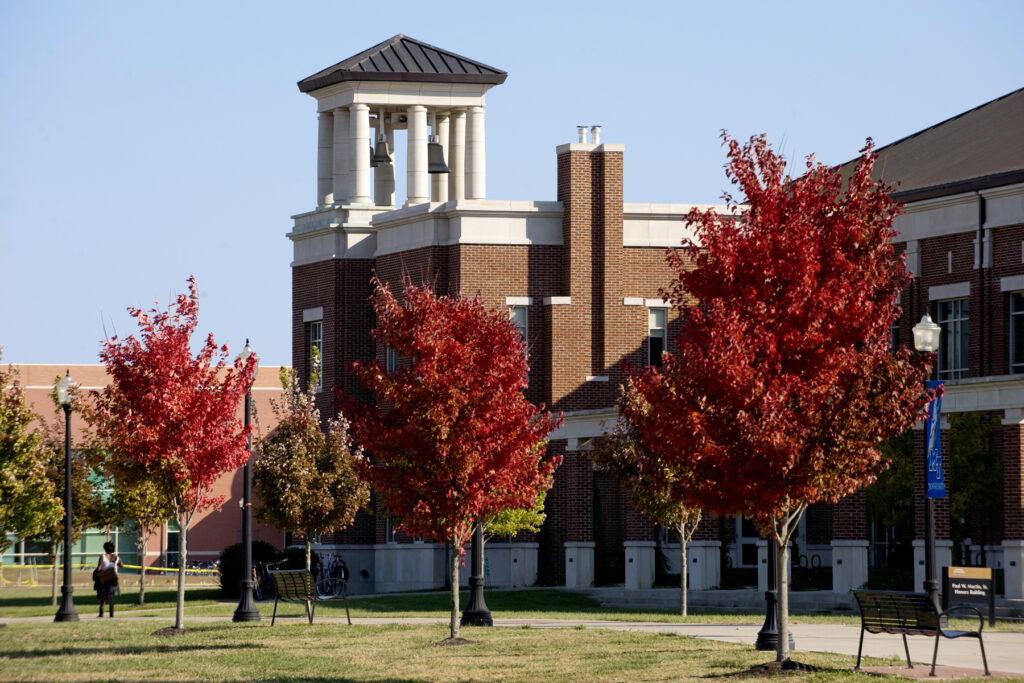
At the heart of the Paul W. Martin Sr. Honors Building stands one of the most defining features of the Honors College: the bell tower. More than an architectural focal point, it serves as a symbol of academic tradition. Moreover, it is a marker of time and a source of connection for students across campus.
For centuries, bells have held deep cultural and historical significance. They have been used to signal important events, mark the passage of time, and bring communities together. This happens in moments of celebration, remembrance, and even warning. Their sound has long been associated with both civic life and religious tradition. At times, it represents joy, solemnity, or even the voice of something greater.
On college campuses around the world, the bell has become one of the most enduring symbols of education itself. While images like the torch, lamp, or apple may represent learning, the sound of a bell uniquely captures the rhythm of academic life. It announces beginnings, endings, and milestones along the way.
At Middle Tennessee State University, the Honors Bell Tower carries forward this rich tradition. The tower houses four specially tuned cast bronze bells, designed to produce melodic chimes when struck in sequence. This practice of creating musical tones through coordinated bell ringing dates back centuries, with early examples originating in China. Today, that same tradition resonates across the MTSU campus, offering a familiar and welcoming sound to students and visitors alike.
The bells themselves were crafted by the Van Bergen Company of Charleston, South Carolina, a respected firm known for supplying bells to institutions such as Davidson College, the University of the South, and the University of California, Berkeley. Their presence at MTSU places the Honors College within a broader tradition. This tradition is shared by universities nationwide.
Yet, what makes the Honors Bell Tower truly special is not just its history or craftsmanship—it is the role it plays in the lives of Honors students today.
Since 2005, a meaningful tradition has brought new life to the tower’s chimes. Following each successful thesis defense or creative project presentation, a special peal of the bells is sounded. With the simple press of a remote control by a student’s advisor, the bells ring out for several minutes. Therefore, it signals to the campus community that an important milestone has been reached.
This moment transforms a personal academic achievement into a shared celebration. Students leaving their defense hear the bells not just as a sound, but as recognition of years of dedication, curiosity, and perseverance. Additionally, faculty, classmates, and passersby alike become part of the moment, even if only briefly, through the familiar and uplifting sound carried across campus.
First introduced in November 2005, the tradition quickly became a cherished part of the Honors experience—one that continues to mark the culmination of undergraduate research and creative work. It does so in a way that is both simple and profound.
Today, the Honors Bell Tower stands as more than a landmark. It is a living symbol of academic achievement and community, bridging past and present through sound. Importantly, each chime serves as a reminder that education is not only about the pursuit of knowledge, but also about the moments that define the journey.
Two students from Middle Tennessee State University have been selected for competitive National Science Foundation-funded Research Experiences for Undergraduates, or REU, programs at universities across the country this summer.
“These experiences provide opportunities for students to conduct advanced research alongside leading faculty mentors while building confidence, independence, and professional skills,” said Jamie Burriss, director of MTSU’s Undergraduate Research Center.
The students will conduct research through programs supported by the National Science Foundation. In these programs, REU provides undergraduate students with opportunities to participate in advanced research alongside faculty mentors. Additionally, the experience helps them prepare for graduate school and future careers in science, technology, engineering and mathematics, known commonly as the STEM fields.
Dalyn Wachala, a mechatronics engineering major, will participate in a robotics-focused REU program at West Virginia University.
“To be honest, my first reaction was pure shock,” Wachala said after learning of his acceptance. “I knew how competitive the program was, and I wasn’t sure if I would be selected. Once it finally sank in, I was just incredibly happy and grateful.”
Additionally, Zahraa Al Rubaye, a biochemistry major and Honors student, was selected for the Collaborative Approaches among Scientists and Engineers, or CASE, REU program at Auburn University.
Al Rubaye said she is excited to gain firsthand experience conducting professional academic research while developing new technical and analytical skills.
“I’m excited to develop and refine my research skills to a more professional level,” she said. “I cannot wait to learn about what it means to conduct research in an academic and professional field, as well as contribute to the development of a new project.”
She said the opportunity will help prepare her for future research environments and strengthen her long-term academic goals.
“I think the research opportunity will solidify my passion in research and further my interest in pursuing a dual doctorate degree in research and the medical field,” she said.
Wachala said he is eager to expand his knowledge of robotics research while also experiencing campus life away from home for the first time.
“My main goal is to learn as much as possible about robotics, so I am very excited for the research itself,” he said. “On a personal level, I am also looking forward to experiencing dorm life. I have commuted from home during my time at MTSU, so staying on campus at WVU this summer will be a brand-new experience for me.”
He credited involvement in MTSU’s robotics club with sparking his interest in the field and building the confidence to pursue research opportunities.
“The spark really started when I joined the robotics club here at MTSU,” Wachala said. “Getting to immerse myself in a real project for the first time was a feeling I truly loved.”
“These students represent the very best of MTSU’s growing undergraduate research community,” said Burriss. “Their selection into nationally competitive NSF-funded REU programs speaks to their talent, dedication, and readiness to contribute to meaningful research experiences beyond our campus.”
“Scholarships at MTSU changed the trajectory of my education. Funding for my degree provided more than just financial relief. It gave me the freedom to pursue four years of undergraduate research and three life-changing programs abroad. I am incredibly thankful for scholarships from the College of Basic and Applied Sciences and the MTSU Honors College. These awards ensured that my entire collegiate experience and every professional development opportunity remained entirely cost-free.”
National scholarships and fellowships are competitive awards that support research, graduate study, public service, leadership development, and international experiences. Unlike MTSU scholarships or financial aid, these opportunities are funded by external organizations such as government agencies, foundations, and educational institutions.
Examples include the Goldwater Scholarship for STEM research, the Truman Scholarship for public service, and the Fulbright U.S. Student Program for teaching, research, and study abroad opportunities. In addition to funding, the application process helps students develop writing, interview, and professional skills while clarifying future goals. There are typically two kinds of options.
Nominated or Campus-Reviewed Scholarships
Some scholarships require review, endorsement, or nomination by MTSU before students may apply nationally. These opportunities often have campus deadlines that occur well before the national deadline.
Open scholarships do not require nomination from MTSU. Students apply directly to the sponsoring organization, though the Undergraduate Fellowships Office can provide guidance throughout the process.
Students are encouraged to begin exploring opportunities early. Strong applications take time to develop and benefit from reflection, revision, and feedback.
National fellowships and scholarships can open doors to study abroad, research opportunities, graduate school funding, internships, and career development. While every program has different requirements, successful applicants often share a few common habits.
1. Get Involved
One of the best ways to prepare for competitive opportunities is to become involved on campus and in your community. Join organizations, volunteer, participate in leadership roles, and explore activities that genuinely interest you. Fellowship committees are often looking for students who have made meaningful contributions and demonstrated commitment over time.
Do not wait until an application deadline to create a resume. Keep track of leadership positions, service activities, research experiences, awards, employment, presentations, and other accomplishments as they happen. An updated resume will make applications much easier and help you identify areas where you may want to gain additional experience.
Many fellowships, graduate programs, internships, and employers require letters of recommendation. Strong letters come from faculty members who know you well.
Attend office hours, participate in class discussions, ask thoughtful questions, and seek advice about your academic and career goals. If a professor works in a field that interests you, consider reading some of their research or publications. Developing these relationships early can make a significant difference when you need recommendations later.
4. Look for Ways to Contribute
Successful fellowship applicants often notice what needs to be done and take initiative. Rather than waiting to be asked, look for opportunities to help, lead, organize, mentor, solve problems, or improve a project. Leadership is not always about holding a title. Often, it is about recognizing a need and taking action.
5. Read First, Then Ask Questions
Many fellowship programs provide extensive information online. Before meeting with an advisor, spend some time exploring the Undergraduate Fellowships Office website and reading about opportunities that interest you. Then come prepared with specific questions. Students who do some initial research are often able to have more productive conversations and develop stronger application strategies.
Final Thoughts
There is no single path to winning a national fellowship. However, students who become involved, build faculty relationships, maintain strong records of their accomplishments, take initiative, and actively seek information are often the most competitive applicants. Start early, stay curious, and remember that the application process itself is a valuable opportunity for growth and self reflection.
Robin Lee: Hello and welcome back to another episode of Honors Spotlight, where we showcase the incredible work of students in the Honors College at MTSU. I’m your host, Robin Lee. Today I’m joined by Sarah Huffman, a Buchanan fellow and English major who is diving deep into the world of video games for her thesis. Her project is titled Halo Reach: Humanity’s Desperation in the Face of Adversity. For those who may not know, Halo Reach debuted back in 2010 and quickly became one of the most beloved entries in the Halo franchise. Sarah’s thesis explores how the game embodies the indomitable human spirit and uses narrative, environment and player psychology to highlight humanity’s struggle in the face of overwhelming odds. So, Sarah, thank you so much for joining me today.
Sarah Huffman: Thank you. It’s a pleasure to be here.
Robin Lee: I must start this episode by letting listeners know that, at the time of this recording, you are still finalizing your thesis project and will hopefully defend it successfully this semester. So, in your thesis proposal, you mentioned that you started playing Xbox last summer.
Could you tell me a little bit about yourself and your background, and what drew you to working at a video game store with little prior experience in the video game industry?
Sarah Huffman: So, as you said, my name is Sarah. I am an English major with minors in both interactive media and university honors. I’m actually a first-generation college student, and I graduate this December 2026. Um, I am a commuter, just as you know. I do drive an hour here every single day. It is a trip, but I love it. Um, I am working to be a professor, specifically with video games as literature. I am also working to get my PhD. Sorry, this is so odd, and I actually have had prior experience. Um, not crazy prior experience I had. It’s been a while since I got back into the console world. I had been messing with my PC. Um, it had been since the 360-era when I was a kid. I played a lot of the girlier games because during that time, it was still a huge gender divide. I never really got to get into the huge franchises that we know and love from these eras. Halo: Reach actually does take place during the 360 era, so I did miss it. I started playing with my fiancé, who is now at the time of recording. Yesterday, he left for Marine Boot Camp, and I played with him the whole time. It was recommended to me by my boss. When I started working at Game Exchange, I didn’t have a lot of information on, like, retro consoles. I’d always thought it was really nice. I had always loved older consoles and seeing how they work, how they function, but I had always had a love for newer eras, as most people do. However, I think it’s really important that we keep video game history alive. I actually have a friend who works with video game archival, and that’s a whole other field. But as I was, as I asked my boss, sorry, I’m going to restart that. I had asked my boss, Hey, what game should I play? I just got a Series X. I had been dying to get back into this. What should I do? And he was like, you need to play the Halo franchise, but you need to play in chronological order. First, chronologically, Halo: Reach for everything. So, I went into this completely blind. Didn’t know I had my fiancé play with me for the first time, and it was generally one of the best experiences I think I’ve ever had. I know I don’t remember which Halo game it was, but one of the Halo games was one of the first games that I ever played in the online environment.
Robin Lee: Um, for me, it’s kind of funny when you refer to like 360 as an older console because I’m like, I remember Atari. Okay.
Sarah Huffman: Yeah. Actually, I got news this morning that the president of Sega has passed away. Um, gosh, I it is it is very sad. Um, but like when I was a kid, like I had a 360, I had a Wii, I had my 3DS XL, I still have them, I still have the 3DS XL, my Wii, and my 360 given out. But I, I had mainly just life gets busy and can’t play all the time. And unfortunately, that was me.
Provide the listeners with a little bit of an overview of your thesis project and why you chose Halo: Reach specifically as your subject.
Sarah Huffman: So my thesis is an analysis of Halo: Reach through a literary lens. I focus on hope, and this never-give-up attitude. The why we need to survive, why we don’t give up the indomitable human spirit. But specifically, reach is very different because throughout the whole Halo franchise, we see hope through Master Chief, through this beacon of hope and light, and the hero who never dies, never gives up, but reaches a little differently because you’re not Master Chief Noble Six, who you play as, is a vessel for the player. Now he is a standalone character, as we know, and we look at it like chronological history, and we can go into law on that. But you are playing as a vessel of yourself. And the idea that hope is something that’s fleeting, that we must stay strong and we have to keep going no matter what. When everything looks bleak, and when life looks like everything is going to fail. And in reality, you do fail. That’s completely different from the dramatic irony of you seeing yourself failing at the start. At the complete start, you are going to see yourself. You see a picture of a broken helmet, and then it cuts to a scene where you’re putting on that helmet and you know, ooh, something’s not gonna go well. But Halo Reach was Bungie’s goodbye before 343 Studios took over, and I think it is so beautiful and has such a strong emotional impact on me and who I am now, and why we continue to fight every single day.
Robin Lee: Absolutely. I think one of the most powerful themes of Halo Reach is that false hope narrative. You even describe the game as using false hope to drive the narrative in your thesis proposal. So to me, this draws on the dramatic irony that players already know the fate of reach before the game begins. The planet will fall to the covenant. Yet as you play, you get the moments that feel like victories. You get to complete missions, defeat your enemies, and secure objectives. Each win feels like progress, but the larger war is unwinnable. So, can you explain what you mean by false hope in this context and how you feel players experience it?
Sarah Huffman: So like I said, the false hope is the dramatic irony. It’s like I mentioned earlier, you see yourself, or you see Noble Six’s helmet on the ground. There’s smoke. It’s not a good situation. The helmet actually is through the visor. It’s broken, and you kind of know, like, oh, oh, something’s not right. And then you switch to putting that helmet on, and you go in, and we get to see an able team. We get to look at everybody, and we’re like, oh, maybe it’s okay. Maybe everything will work out. But there are so many small victories that the player wins. But this win is actually the downfall of the entire Noble team, all this false hope. The victories that you win, you’re given. Okay, maybe. Maybe there’s a chance. There’s a chance that I can live. There’s a chance that everyone here can live. And we can savor each. And we can. We can all live happily ever after. But you, you can’t. There’s absolutely nothing that you can do. And I felt it going in completely blind. I had hoped we could win, and maybe I could change it. Maybe there is something else that I could do. Because the hero always wins. Master Chief always wins. I knew that, I knew that, you know, and in the FBS genre, the first-person shooter genre, the protagonist is always successful. That is like every action movie and hero movie, and all of these strong, capable beings. I mean, you’re a super soldier. You should win, right? You don’t. You are a hero who dies. And in reality, you’re not really remembered that much. You’re kind of in the background. And. This false hope, this ending, the ending of Reach is the lone wolf mission. Now, you have to do this on by yourself, no matter how long. The only goal is to survive. That is where we get that meme from is Halo: Reach Lone Wolf Mission. No matter what you do, you can last hours. There’s like a record out there for how long you can last in this, but no matter how long, you can’t change it. People have tried. We can’t change that. And that false hope is so strong and so impactful that I remember bawling my eyes out.
Robin Lee: Okay, so I need to interject real quick. Hopefully, we are not spoiling this for anybody. This is a game that’s more than fifteen years old. If you haven’t played it, I’m sorry. So the game design may have some psychological effects. As you mentioned, you were really upset.
Sarah Huffman: I cried at every death. Don’t worry.
Robin Lee: It manipulates players into believing that they might save reach despite knowing the cannon behind the game, the adrenaline of digitized combat, the bond with Noble team, and that immersive environment fuel this illusion. When the inevitable collapse comes, the emotional impact is stronger because, and this is where I date myself again, but like David Duchovny’s character in X-Files, the players “want to believe.” But that’s what I love about this topic in particular: it connects with people. No matter what your background is, what your age is, or what kind of games you’re into. So, back to my original point.
How do you think that dramatic irony shaped your emotional journey while playing the first time and the second time, even?
Sarah Huffman: As I said, I had absolutely no spoilers for the first time. I had kind of guessed during all of it. I was like, Oh, everyone’s going to die. I was like, no one’s making out of this alive. Which spoiler one person actually does. The only reason that Joon, the sniper of Noble Team, gets out alive is that he is the one who stays with Halsey to get off. And also a fun fact, Joon is one of the trainers in the later Spartan generations. If you don’t know, while I was playing, I was sharing my thoughts with my fiancé, and I was like, Oh, this is bad. This is horrible. Like, I knew, like, it is that dramatic irony. It’s the I know that something’s going to happen, but I’m waiting, and I’m hoping maybe I can delay the inevitable. I wanted to believe. And like I said, I cried. I cried a lot. I wanted to cry while writing this. I was writing about the character deaths, specifically Kat’s death. And I think hers is the most realistic. And I was sitting in their library writing, and I was like, oh, I just want to cry. I’m listening to the soundtrack, and I’m like, oh, ooh, I get goosebumps even just thinking about it. But the second time I started playing through, um, I actually, on the second playthrough, first playthrough, I played on the Master Chief collection. In the second playthrough, I played the original. I have the original disc with everything included. In fact, it had a code that I could actually redeem. Unfortunately, I can no longer redeem it because I’m a year too late. But that bittersweet feeling of oh, I know how this ends, but I get to reconnect with him over again, and I get to look once again at all these characters that I love, and I know they’re gonna leave me. And I think that’s what Bungie does so well in Reach, is that it is so realistic that when you when in a war scenario and you’re just introduced to a team, you get to know them little by little as they open up and they get accustomed to you, but then they’re ripped away dramatically. Every single time that you get closer to a character, that character is ripped away. And it is tragic, and going in knowing it again. It’s so bittersweet, and I could cry.
Robin Lee: Now don’t cry. We’re talking about the indomitable human spirit here.
How does that cultural idea connect to Noble Six’s final stand in the game?
Sarah Huffman: Okay, so Lone Wolf is the lone mission that you have. You’re by yourself. You have to absolutely play by yourself. I had to play by myself, and this indomitable human spirit was a quick background in spirit. The meme kind of goes, oh, you know, there’s one less human. The aliens are like, oh my gosh, why isn’t this human dying? I mean, this person likes some of these memes that they have their arm ripped off, like, they’re like crawling on the ground. But we see, like, in real-life scenarios, people have lifted actual cars off their children. And lifting a car by yourself is hard. It’s rough, people. The reason is that when we’re in these life-or-death scenarios, and our fight-or-flight kicks in, it’s adrenaline. Adrenaline kicks in. It gives us these superhuman powers. And now, mind you, this is technically like a superhuman. He’s a Spartan three.
Robin Lee: So he has been genetically modified, like Captain America.
Sarah Huffman: Yeah. Kind of. It’s. It gets into, like, a whole, like, ethical situation, but like these, these people are, like, trained from, like, kids. So it is, it’s a whole ethical problem, but that adrenaline release keeps you going. And at the very end, you see, you see number six. And as I said, you can’t escape it. But he fights till his last breath. He fights a swarm of elites. Mind you, elites are. Or the Sangheili, the elites. They are some of the most powerful foes in the game. They are a pain in the butt. And they’re known as these generals. And they’re really powerful military figures. Their whole culture is literally about how many people you kill, and like your honor and your military, and how strong we are. But it took a whole swarm of them to kill Noble Six.
Robin Lee: So he’s the John Wick of the franchise?
Sarah Huffman: Kinda. Yeah. He’s kind of like John Wick. He is so strong, and like, it’s hyper lethal, is what they call them. There are only two people in the whole franchise. It was Master Chief and Noble Six, mind you. Fun fact about Noble Six was that he was going into these missions, where, like before, before all of before Reach, he was supposed to die. They sent him on suicide missions. Spartan threes are meant to be disposable. Super soldiers. Super soldiers. Excuse me, but Noble Six just kept coming back, and they were like, oh, oh, you’re. Why are you still here? So, as the original Noble Six and Noble team die, they send Noble Six in. And this was the final bit where he dies. And also, at the start of the game, like your whole, like, background information is blacked out. It is like maybe a few words. It is a government document. It is. Oh, but you keep fighting no matter what. Lone wolf, I think, the mission of the indomitable human spirit is when everyone’s dead. It’s just you left. Fight! Objective. Survive. That’s it.
Robin Lee: So, as an English major, you definitely understand the importance of having a good storyline in the background. Um, you’re bringing literary and narrative analysis into game studies. How do you see video games fitting into the broader field of storytelling alongside literature and film?
Sarah Huffman: So, really quickly, the first thing you learn in literary studies is that the class literature is just storytelling. A big misconception is that literature is just novels and the classics. You know, The Picture of Dorian Gray, we have Moby Dick. But in reality, literature is just storytelling. That’s all it’s ever been. In video games, do just that. No, of course not all of them. Mario Kart is not an example of literature. Um, I mean, you could make it literature if you made a story with it. But games like Reach, like Night in the Woods, are beautiful. Absolute literature. And when we look at video games and literature, we use techniques from both traditional literature, such as novels and film studies. So in literature, obviously, we have to do like the close reading and stuff like that. And like film studies, we look at the actual like what’s on screen. But the difference, and I argue the most impactful thing, is that this form of literature is interactive. You are participating in this story rather than just consuming it. Your methodology includes replaying Halo Reach and comparing it to other Halo titles. From my experience with most Halo titles, Master Chief embodies genuine hope, overcoming impossible odds. In contrast, Noble Six embodies false hope. He’s fighting bravely, sure, but destined to fail, and I think this makes reach unique in the franchise.
What differences stood out to you between Reach and the mainline Halo games featuring Master Chief?
Sarah Huffman: Now let’s look at let’s look at Master Chief and Noble Six. Just straight off the bat. Master Chief is a Spartan two. They are considered humanity’s deadliest weapons. They are. They’re taken from, like, six years old, and they are given a bunch of drugs. Spartan twos are I’m gonna just restart that. So, let’s look at Master Chief and Noble Six. Master Chief, who is the main protagonist of the Halo franchise, is a Spartan II. Spartan twos are the. The deadliest weapon that humanity has ever created. They are taken from six-year-olds and molded into these superheroes. Genetically, they have surgery done on them. It is a whole process. They are considered just as good, like the age of thirteen. They’re considered just as good as their special operatives. And that’s pretty intense. Now, number six is Spartan three. Spartan threes were, of course, the generation after, but they were created to be disposable. They are a lot cheaper. They are just orphans who volunteered. Which makes it, I guess, a little more ethical. But they’re not given as much there. It’s made to be really cheap and to just keep spitting them out so we can keep fighting. That’s like one of the biggest differences between them: number one, their backgrounds, but also, Master Chief is made to fight anything legit, anything. A scarab, a huge, huge ship. Master Chief can take it down by himself. And he did. Noble Six can’t. In fact, there is one in reach. But instead, it’s towards the very end. And Emil and Noble Six are getting ready to deliver Cortana to the Pillar of Autumn. Now, Carter has ejected them from the ship, saying, Hey, like I’ve been shot. Get out. I’m gonna take from the skies. And Carter sacrifices himself, goes, flies right into the scarab. And now Master Chief could have done that by himself. Carter can’t. Carter has to use his ship. Like, one of the big things in Halo is Master Chief. I’m like, I’m giving the covenant back their bomb. But they can’t do that. And it’s sad. That’s why Spartan threes are in more teams than they’re meant to be. Teams rather than Spartan two measures you can just be by himself, and their body language is different now. When Master Chief walks into a room, you can see that the whole franchise, you can see he kind of knows what he’s talking about. And it’s kind of this like, oh, like it’s more I don’t want to say necessarily relaxed, but it’s confident. Now, I’m not saying that Noble isn’t confident, but it’s more cautious, more. I have to look out for my surroundings just a little bit more because I could die more easily. Now. Reach there’s the game has hope in a different life now. My chief is a beacon of hope. He is the hero. When we think of Halo, we think of Master Chief and Cortana. That’s it. But normal six passes that torch to Master Chief. Without Noble Six, there would be no Master Chief and Cortana. Because if Cortana had not chosen Noble Six to deliver her to the Pillar of Autumn to Master Chief, humanity would not be saved. But we kind of forget about that. We just say, “Oh, yeah, Master Chief.” Master Chief, save humanity! Hooray! But this hope is just. Chief is this hope that is always there and never fails. And then if we look at novel six and reach, you do fail. But your failure is success. It’s a whole thing where, like, the player’s success is ultimately the protagonist’s downfall. But in this sense, the player’s success and the protagonist’s downfall mean the success of humanity in the setup for the rest of the games.
Robin Lee: Okay, so to help kind of close this out, what do you hope that listeners or even players take away from your thesis about Halo Reach in the way that video games can explore themes of hope, loss, and perseverance?
Sarah Huffman: One of the biggest things is that everybody needs to find their hope. You need to find your reach. Your reach will change depending on the situation and what’s happening. Like, my reach has changed. No matter what. And you have to keep fighting. No matter what. You have to fight. Um, in reach. Throughout all odds. You keep fighting, you keep adapting, you keep going. And there are going to be times when everything is hard. And there are days when I just don’t want to get up. And I fully admit that. But we have to keep going. We have to find that hope in, keep our reach in our hearts, and keep going. It is up to you, as my father says, Fred Huffman, ladies and gentlemen, if it is to be, it’s up to me. That was my senior quote, too. I’ve been taught that my whole life. And one of the biggest takeaways from reach is that you have to keep going. It is up to you. There are days you’re going to say, or you’re going to feel like, oh, I, you know, I can’t and I won’t. I’m telling you, you can and you will. And if there’s anything that taught me, it’s that to keep going no matter what and to keep fighting, always fight.
Robin Lee: Sarah, thank you for sharing your insights with us today. Your thesis not only highlights the depth of Halo Reach as a game but also shows how video games can serve as powerful narratives about humanity, resilience, and sacrifice. I believe the tension between hope and futility is what gives the game its lasting impact for our listeners. Remember that the Honors College is home to students like Sarah, who are pushing boundaries in their fields, whether through literature, science, or even video game studies. This has been Honors Spotlight, and I will see you next time as we continue to shine a light on the remarkable work of our honors students, alumni, faculty, and staff. Be sure to subscribe so you never miss an episode!
Middle Tennessee State University hosted an in-depth and wide‑ranging panel discussion recently titled “War in Iran,” bringing together three campus experts to assess the rapidly escalating conflict that has drawn in Iran, the United States, Israel, and several Gulf states.
Sponsored by the Honors College and the American Democracy Project, the panel inside the College of Education Building offered sobering analyses of how the war began, why it has intensified, and what its consequences may be for the Middle East and the world.
Honors College professor Joan McRae opened the event by outlining the gravity of the moment: a war that began amid Iran’s internal unrest has now exploded into a multifront regional conflict. Attendees filled the room to hear assessments from three faculty experts whose fields span Middle Eastern history, military strategy, and international politics.
Operation Epic Fury and a region under strain
Sean Foley, professor of history and a specialist in the Middle East, who is also a nonresident fellow at the Arab Gulf States Institute, began with an overview of what he described as a conflict that has already “sent shockwaves around the world.”
According to Foley, the United States and Israel launched what has been named “Operation Epic Fury” on Feb. 28, initiating thousands of strikes on military and political targets in Iran, including an attack that killed Supreme Leader Ali Khamenei. Iran has retaliated with ballistic missiles and drones across the region, striking Israel, U.S. bases, and numerous Gulf energy facilities.
Foley emphasized the unprecedented economic impact of Iran’s successful efforts to restrict shipping through the Strait of Hormuz, one of the world’s most critical choke points for oil and gas. With tankers grounded and refineries damaged across the Gulf, energy prices have surged worldwide, prompting governments from Thailand to India to impose emergency measures ranging from reduced workweeks to limits on electricity consumption.
Lebanon, Foley added, has suffered devastating consequences as Israeli operations have displaced over a million people — nearly a fifth of the country. “This is one of the most significant refugee crises Lebanon has ever experienced,” he said.
Strategic middle game with no clear end
Following Foley, Luke Truxal, a historian of air power and U.S. military strategy, framed the war as entering what he called the “middle game” of a long chess match. Truxal argued that the U.S. and Israel appear to be seeking regime change in Iran, an objective he said has no historical precedent for success through airpower alone.
“There is no example of a bombing‑only strategy achieving regime change,” Truxal stressed, citing Vietnam, Afghanistan, and other major conflicts. The U.S., he said, seems to have underestimated both Iran’s resilience and its ability to strike back through a coordinated oil‑targeting campaign that mirrors historically effective “oil offensives” used in conflicts from World War II to modern Ukraine.
Truxal also warned that rising civilian casualties inside Iran, especially the widely condemned missile strike on a girls’ school that killed almost 170, mostly children, are likely to strengthen hardline factions and deepen public support for the Iranian government. Iran’s capacity to wage drone warfare and overwhelm U.S. air defenses, he said, increases the likelihood that Washington will face pressure to commit ground forces, an outcome he called “deeply concerning.”
Global power, politics, shifting landscape
The final speaker, Andrei Korobkov, professor of political science, analyzed how the conflict intersects with global power competition. He argued that Russia and China, while not militarily involved, are positioned to benefit strategically as U.S. attention and resources shift away from Europe and Asia.
Korobkov highlighted surging oil prices, which have doubled Russia’s projected oil revenue, and shifting alliances across the Middle East. At the same time, he cautioned that Gulf states facing attacks on refineries, desalination plants, and population centers are confronting “social time bombs” due to high dependence on foreign labor and imported food.
While some observers speculate that the BRICS nations (an intergovernmental organization comprising 10 countries) may deepen their alignment in response to U.S. actions, Korobkov noted that internal rivalries, particularly between Iran and Saudi Arabia, complicate hopes for a unified response.
During an extended Q&A session, audience members asked about U.S. public opinion, the likelihood of a diplomatic settlement, religious narratives, Kurdish involvement, and the potential for retaliatory attacks on U.S. soil. Panelists consistently noted that polling shows Americans largely oppose the war and that diplomatic progress is unlikely in the near term.
Foley concluded by quoting a Somali proverb: “The game has a second half.” How the conflict evolves from here, he said, will depend on which actors adapt most effectively to a rapidly changing strategic environment.
The panel was recorded and will be available to watch on True Blue TV.
Middle Tennessee State University will host its third annual Fulbright Day on Tuesday, April 14. It will feature dedicated virtual sessions for students at noon and for faculty at 1 p.m.
The event is being coordinated by Mary Ellen Sloane, associate director of the Tennessee STEM Education Center, and Laura Clippard, undergraduate fellowships director and Honors College advisor.
The virtual event will inform and support students and faculty interested in international exchange through the Fulbright program.
The day will include two targeted Zoom sessions:
Student Session – Noon
Topics include:
Research grants
English teaching assistantships
Creative arts awards
Covering eligibility
Application components
Tips for developing strong proposals
Faculty Session – 1 p.m.
• Mary Ellen Sloane and a Fulbright representative outline global teaching and research opportunities through the U.S. Scholar Program, highlighting award types such as Scholar Awards, Postdoctoral Awards, and Distinguished positions across 130-plus countries.
• Panelists Greg Reish, musicology professor, and Sylvester Lamin, social work associate professor, share their Fulbright experiences. They offer guidance on the application process, securing host institutions, and the professional benefits of expanded teaching and research networks.
• Chemistry professor Sing Chong closes with an overview of the Fulbright Scholar-in-Residence program. The program brings international scholars to U.S. campuses to teach, lead workshops, and support internationalization efforts.
Additionally, one-on-one drop-in advising sessions will provide individualized guidance on project ideas, application strategy, and program fit. These sessions will take place between 2 p.m. and 4 p.m. on the same day.
Why Fulbright matters at MTSU
The Fulbright Program is one of the world’s leading international exchange initiatives. It offers opportunities for both students and scholars to conduct research, teach and build global partnerships. Fulbright Day at MTSU underscores a truth the university sees year after year. When students are given the chance to step onto the world stage, they return transformed and ready to lead.
Recent awardees show how these opportunities expand far beyond travel. Alumnus Josh Narrell, for example, turned years of studying German and exploring intercultural communication into a Fulbright English Teaching Assistantship in Hamburg, Germany. There, he is building bridges across cultures and bringing home new insight into global youth engagement. He is also one of the key speakers for the student session.
Other students demonstrate how Fulbright-linked programs open doors to cutting-edge research and global problem-solving. Computer science major Jake Salter earned a Fulbright Canada–Mitacs Globalink Research Internship. He used decades of pollen data to study ecological change while gaining access to Canada’s top research institutions. His path from music major to data‑driven researcher shows how international fellowships help students discover new academic identities and contribute to urgent global conversations.
Even first‑year students can step into the Fulbright pipeline. As a freshman, political science graduate Victoria Grigsby earned a place in the Fulbright Summer Institute in Wales. There, she studied identity, nationhood and migration while engaging directly with Welsh communities and policymakers. Her selection highlights how MTSU’s commitment to global learning begins early and empowers students to see themselves as ambassadors long before graduation.
Recent faculty awards
• Sylvester Lamin (associate professor of social work) — Awarded a Fulbright U.S. Scholar grant to Sierra Leone at Fourah Bay College, University of Sierra Leone. Lamin focused on teaching social work courses, advancing curriculum development, and conducting research on social services. In addition, he engaged in community initiatives to strengthen educational and professional resources in his home country region.
• Gregory Pitts (professor of journalism) — Recipient of a Fulbright U.S. Scholar award to Georgia (the country). His project emphasized journalism education, media studies, and professional development, fostering cross-cultural exchanges in media practices and democratic communication in the region.
• Guanping Zheng (director, Center for Asian Studies) — Selected for a Fulbright U.S. Scholar grant through the U.S.-Taiwan International Education Administrators Seminar in Taiwan. Zheng participated in professional development activities to enhance international education programming, build partnerships, and promote Asian studies initiatives at MTSU and beyond.
• Gregory Reish (professor of musicology and former director, Center for Popular Music) — A prior recent awardee (Fulbright-García Robles U.S. Studies Chair) to Mexico at the Universidad Veracruzana in Xalapa. He taught courses on U.S.-Mexico relations and popular music. He conducted research and contributed to North American Studies programs, demonstrating MTSU’s sustained Fulbright success. This has led to more recent awards.
• Ngee Sing Chong (professor of chemistry and director of the Interdisciplinary Microanalysis and Imaging Center) — Hosted a Fulbright Scholar-in-Residence. Chong hosted Yong Foo Wong at MTSU last year. During his residency, Wong co-taught an undergraduate chemistry laboratory course and delivered guest lectures in a graduate analytical chemistry course. He also served as an adviser and co-mentor for undergraduate and postgraduate students’ research projects, with a primary focus on analytical chemistry. Furthermore, he conducted research on microextraction, infrared and Raman spectroscopy, and mass spectrometry to evaluate contaminants and additives in food matrices.
Shown here outside the Paul W. Martin Sr. Honors Building at Middle Tennessee State University in Murfreesboro, Tenn., Philip Phillips, Honors College associate dean and English professor, holds a copy of “Poe Spaces: Within and Beyond the Spatial Turn,” which he edited. Phillips was presented the Miembro de Honor award from the Asociación Española Edgar Allan Poe during its fourth international Edgar Allan Poe Spanish Association Conference held in February at the Universidad Autónoma de Madrid in Spain. (MTSU photo by Robin E. Lee)
Philip Phillips, associate dean and professor of English in the University Honors College at Middle Tennessee State University, has received the Miembro de Honor award from the Asociación Española Edgar Allan Poe during its fourth international Edgar Allan Poe Spanish Association Conference held in February at the Universidad Autónoma de Madrid in Spain.
“I am greatly honored to receive this diploma from the Edgar Allan Poe Spanish Association,” said Phillips. “I am especially grateful for the opportunity to collaborate with so many outstanding scholars from Spain and elsewhere on book projects and international conferences on Poe. The work we have done together attests to the enduring and worldwide influence of this great American author.”
The Miembro de Honor designation is the highest recognition bestowed by the Spanish association on scholars who have made significant contributions to the study of Edgar Allan Poe. According to Santiago Rodriguez Guerrero-Strachan, president of EAPSA, Phillips was selected unanimously by the organization’s executive board for his sustained research on Poe, particularly his spatial approach to literary studies.
In its award letter, Rodríguez Guerrero-Strachan cited Phillips’ “significant research” in recent years and noted that his service as president of the Poe Studies Association reflects his commitment to advancing and promoting Poe’s life and work. The honorary membership includes a diploma and lifetime membership in the Spanish association.
“Dr. Phillips is a stellar scholar and a leader in Poe studies, so it is no surprise that he received international acclaim for his contributions to the Academy,” said Leah Tolbert Lyons, dean of the College of Liberal Arts. “We are proud to have him as a member of the faculty in the College of Liberal Arts. He is an exemplar among our outstanding faculty.”
At the conference, which focused on “Poe and Pop Culture,” Phillips delivered a keynote address titled “The Poes and Popular Culture: Edgar, Eliza, and the American Stage.”
Phillips’ scholarship has centered on place, geography and literary space in Poe’s work. He edited “Poe and Place,” and “Poe Spaces: Within and Beyond the Spatial Turn,” both published in Palgrave Macmillan’s Geocriticism and Spatial Literary Studies series. Each volume earned the J. Lasley Dameron Award from the Poe Studies Association for the most outstanding edited collection of essays on Poe, first in 2018 and again in 2025.
Phillips currently serves as president of the Poe Studies Association and continues to publish and present internationally on Poe, reinforcing the university’s presence in global literary scholarship.
“Dr. Phillips is one of the most — if not themost — prolific and accomplished researchers that I have ever encountered during my 27-plus years in higher education,” said Stephen Severn, chair of the MTSU Department of English.
“Scholars in the field of English almost always focus their study on an aspect of the discipline that is relatively narrow in scope. However, he has distinguished himself as a scholar in three areas — one of which is almost wholly distinct from the other two. He can speak with equal (and absolute) authority on Boethius, the fifth-century Roman philosopher; John Milton, the 17th-century British poet; and Edgar Allan Poe, the 19th-century American author. That diversity of academic interest is virtually unheard of in English. And it deserves to be celebrated. Loudly.”